55 templates
General
Starter templates for general, as they appear in the composer. Subject lines show their variables in brackets.
As recipients see them
How these emails look
Rendered by SecureThread’s own email renderer with each template’s example details. Your logo, company details and the facts you fill in replace them when you send.
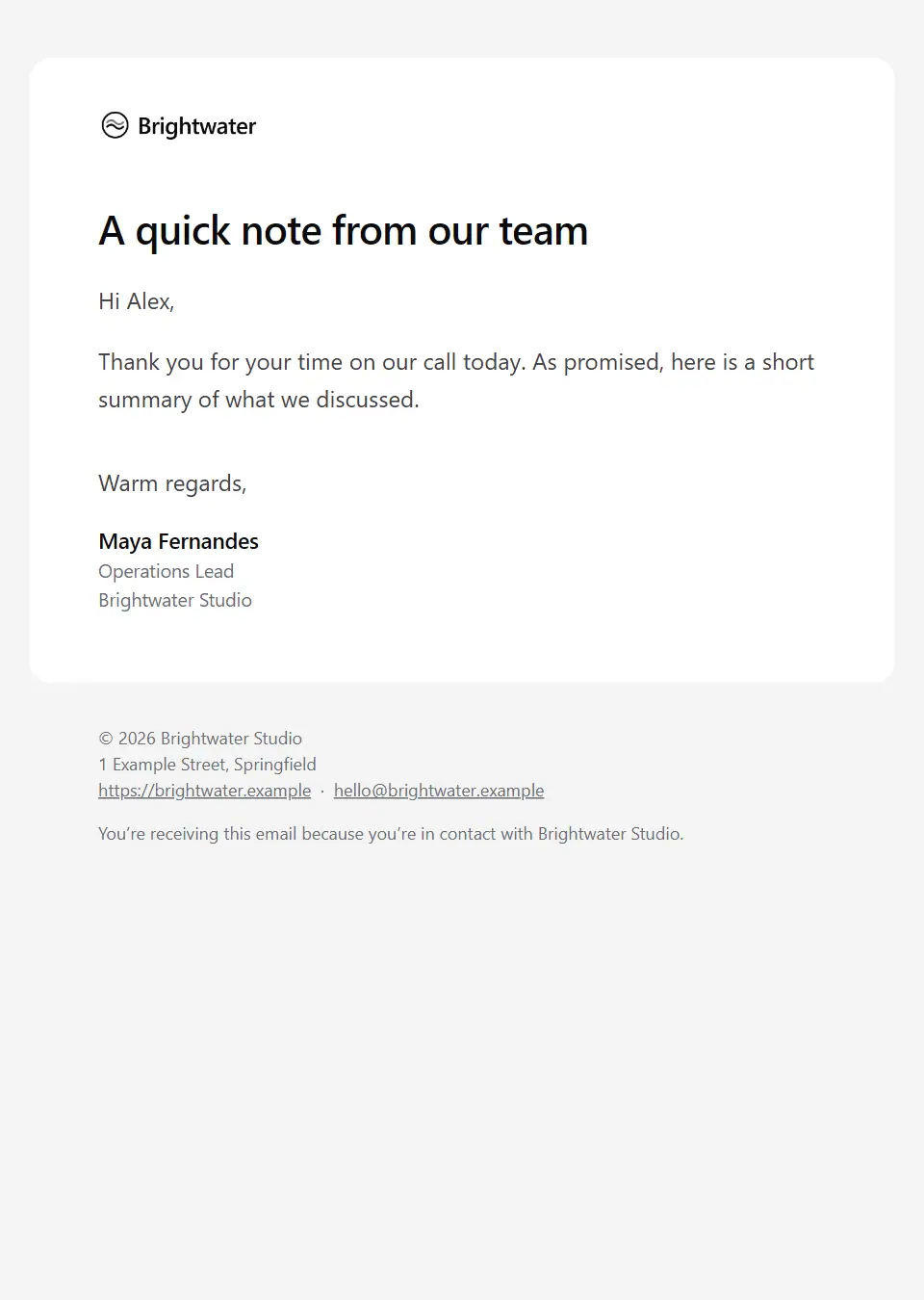
General correspondence
A clean, branded letter for anything else: a headline, a greeting and your message.
Subject: [subject line]
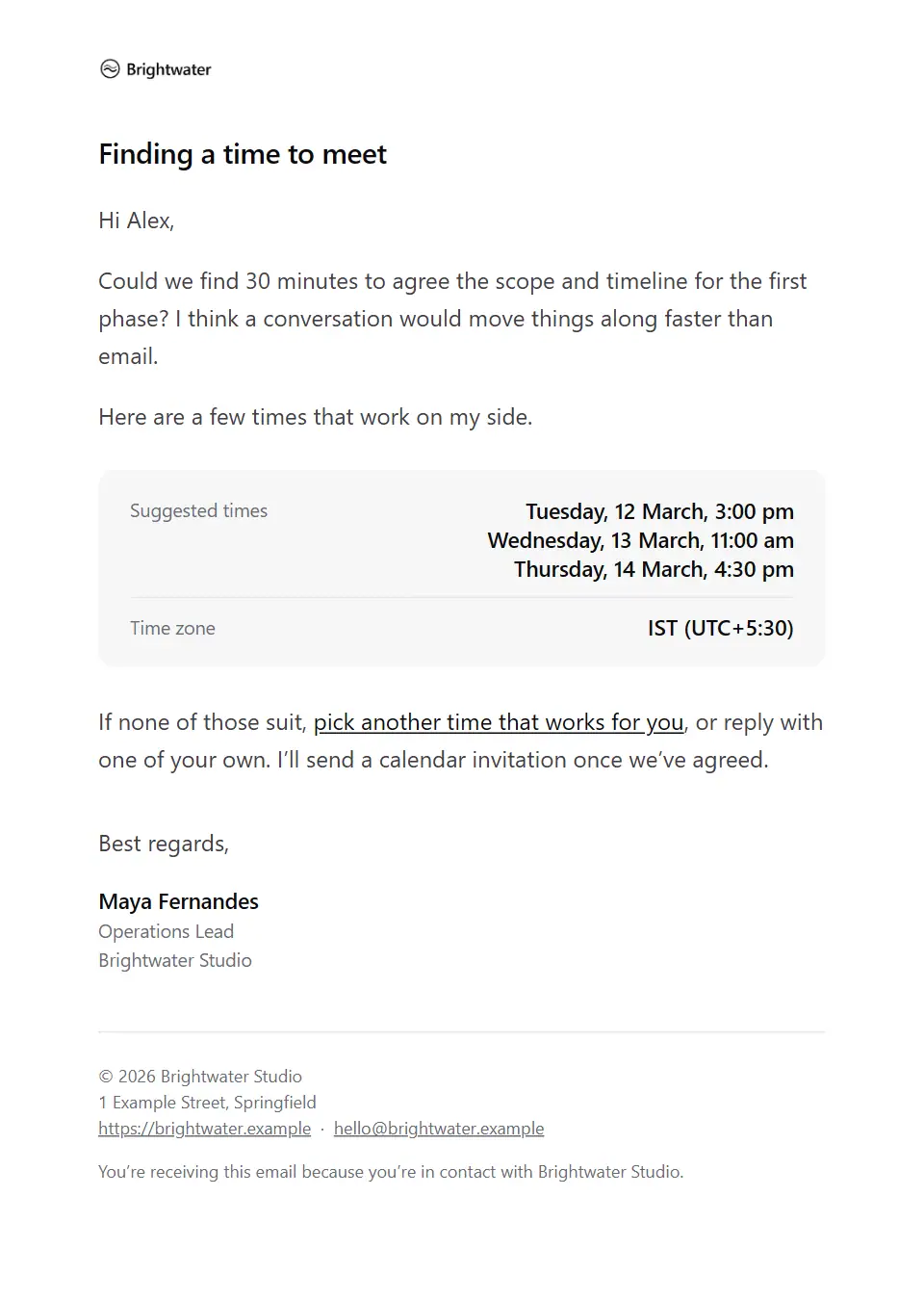
Meeting request
Asks for a meeting in a personal note: a clear purpose, a few suggested times and a link to pick another.
Subject: Finding a time for our [meeting topic] meeting
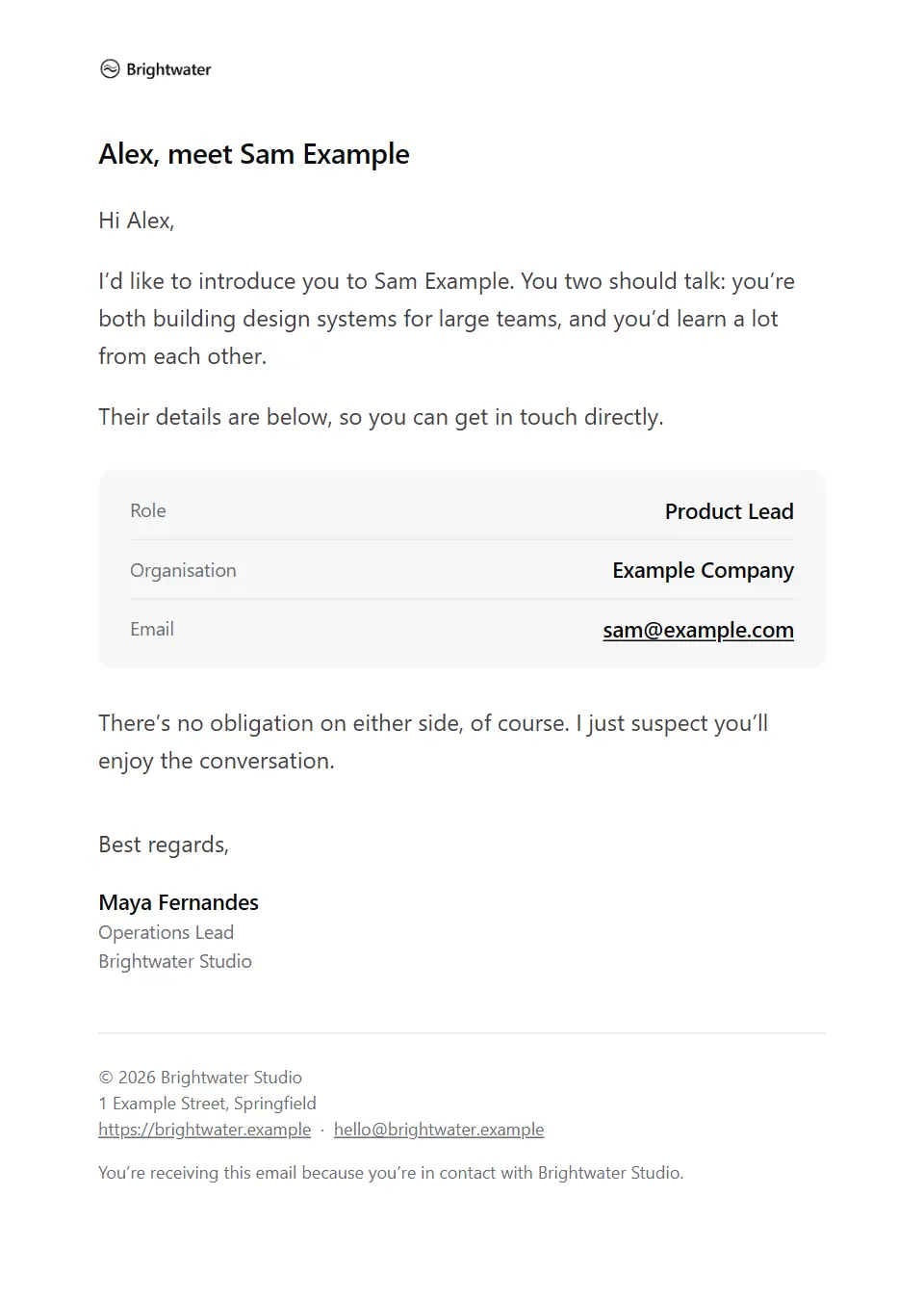
Introduction
Introduces the recipient to someone in your network, with a clear reason for the two of them to talk.
Subject: An introduction: [contact name] at [contact company]
Follow-up after a meeting
Follows up after a meeting or call with the agreed next steps, a link to the notes and one clear ask.
Subject: Following up on our [meeting topic] meeting
Request for information
Asks a client or partner for the information a piece of work needs, as a clear checklist with a date.
Subject: A few details we need for [project name]
Document share
Shares a document in a personal note: what it is, what it covers, a link to open it and when feedback would help.
Subject: The [document name] for [project name]
Thank-you note
A short, personal thank-you to a client, partner or contact, specific about what made the difference.
Subject: Thank you, [first name]
Apology
A sincere, personal apology after a service problem: what went wrong, how it was put right and what will change.
Subject: I’m sorry about [issue summary]
Congratulations
A warm, personal note congratulating a client, partner or contact on a milestone. No letterhead, no ask.
Subject: Congratulations on [occasion]
Availability notice
Tells external contacts ahead of time that you’ll be away, when you’re back and who can help meanwhile.
Subject: Away from [away from]: who to contact
Meeting reschedule request
Asks to move a meeting you arranged, with the current time, a few alternatives and a link to pick another.
Subject: Could we move our [meeting topic] meeting?
Meeting cancellation
Cancels a meeting plainly: which one, why, and what happens next, so the recipient can free up the time.
Subject: Cancelling our [meeting topic] meeting
Follow-up after an event
Follows up with someone you met at an event: what you talked about, one useful link and an open offer to continue, with an easy way out.
Subject: Good to meet you at [event name]
Letter of introduction
A formal letter introducing a colleague who will be in touch on the organisation’s behalf: who they are, why they’ll write and how to reach them.
Subject: Letter of introduction: [contact name], [company name]
New account manager introduction
A new account manager introduces themselves to a client: who they take over from, how the handover was done and an offer of a first call.
Subject: Your new account manager at [company name]
Contact details change
Tells contacts that an email address, phone number or other contact detail is changing, from when, and how to check any change is genuine.
Subject: Our [changed detail] is changing
Holiday closure notice
Tells clients and contacts when you’re closed for a holiday, the last day to send requests and who to contact if something can’t wait.
Subject: Our holiday closure from [closure start]
Recommendation request
Asks a contact to write a recommendation: what it’s for, why them, points they might cover, the deadline and how to send it.
Subject: Would you be willing to write a recommendation?
Reference request
Asks a client whether they’d speak to a prospective client as a reference, sharing their details only if they agree.
Subject: A request: would you be a reference for us?
Thank you for a referral
Thanks a client or contact for introducing a new client: what the introduction meant and where things stand now.
Subject: Thank you for introducing us to [referred company]
Welcome back note
A personal note from a manager or colleague welcoming someone back after time away: what changed while they were out, and time set aside to catch up.
Subject: Welcome back to the team, [first name]
Condolence message
A short, plain letter of sympathy to a client, partner or contact after a loss, with no ask and no need to reply.
Subject: My condolences, [first name]
Permission to make an introduction
Asks someone whether they would welcome an introduction to a contact before you share either person’s details: who the contact is, why the two should talk and an easy way to say no.
Subject: Would you be open to an introduction?
Reply to an introduction
Replies to an introduction someone made for you: thanks the introducer, moves them to bcc and suggests a next step with the person you were introduced to.
Subject: Thank you for the introduction, [introducer first name]
Letter of recommendation
Recommends someone you have worked with to the university, employer or programme that asked for it: how you know them, their strengths with examples, and how to reach you with questions.
Subject: My recommendation for [candidate name]
Formal letter of appreciation
A formal letter from a senior leader thanking an organisation or person for a significant contribution, such as hosting a visit or supporting a project, written on letterhead.
Subject: Our sincere thanks for [contribution summary]
Confidential referral thank-you
Thanks someone for recommending a law firm, accountancy or advisory practice without naming the person referred or saying whether they became a client, since both stay confidential.
Subject: Thank you for recommending [company name]
Apology for a delayed reply
A short apology for taking too long to reply, followed straight away by the answer and the next step. No excuses, and no remedy story.
Subject: Sorry for the slow reply on [message topic]
Apology for missing a meeting
Apologises for missing a meeting you were due to attend, without long excuses, and offers new times or a quick catch-up by email instead.
Subject: Sorry I missed our [meeting topic] meeting
Correction notice to all recipients
Sent from a team to everyone who received an operational email with a wrong detail, such as a date, venue or link: the old and correct details side by side, and what to do if they acted on the old one.
Subject: Correction to our email about [original topic]
Correction to an earlier email
Corrects a mistake, such as a wrong date, figure or link, in an email you sent to one person: the wrong detail, the correct one and what to do if they already acted on it.
Subject: Correction to my email about [original topic]
Notice of an email received in error
Tells a sender that their email reached you by mistake, what you have done with it (not shared it, and deleted it) and, if you know, who it was probably meant for.
Subject: Your email reached me by mistake
Request to delete a misdirected email
Asks someone who received your email by mistake not to open its attachments, share it or use it, and to delete it and confirm by reply. It does not repeat the email’s contents.
Subject: Please delete an email I sent you in error
Committee meeting invitation
Calls the members of a committee, faculty board, department or working group to a formal meeting: when and where, the agenda, items for decision, when papers follow and who takes apologies.
Subject: [committee name] meeting on [meeting date]
Meeting confirmation
Confirms an agreed meeting with one or more people: the date, time and time zone, the place or joining link, who will attend, the agenda and anything to prepare.
Subject: Confirmed: our [meeting topic] meeting
Scheduling poll for a group meeting
Asks several people to mark their availability in a scheduling poll by a set date, with the meeting’s purpose, its length and when the final time will be confirmed.
Subject: Your availability for the [meeting topic] meeting
Request on hold pending approval
Tells a colleague their request cannot go ahead yet because it lacks the approval policy requires: who must approve it, what to send them and what happens once approval arrives.
Subject: On hold until approved: [request description]
Clarification request
Asks whoever sent an instruction, brief or message to clarify specific points before you act on it, with numbered questions that can each be answered in a line.
Subject: A few questions before I start on [work item]
Request for a deadline extension
Asks whoever set a deadline for more time before it passes: the original date, the proposed date, the honest reason and anything you can deliver in the meantime.
Subject: Request for more time on [deliverable name]
Request for a decision
Asks a client, partner or other external contact to choose between options by a set date: the options, your recommendation and what happens if no decision is made in time.
Subject: A decision we need from you: [decision topic]
Gentle reminder before a deadline
A friendly nudge, before the date passes, about something the recipient agreed to send or do: what it is, when it’s due, why it matters and an easy way to say if plans have changed.
Subject: Reminder: [action summary]
Internal escalation to a manager
Escalates an issue you cannot resolve yourself to your manager or a senior colleague: what is happening, the impact, what you have tried, the decision or help you need and by when.
Subject: Escalating: [escalation topic]
Chaser for an overdue internal response
Chases a colleague for input, a decision or a sign-off that is past its agreed date: what is waiting on it, the impact of further delay and the new date it is needed by.
Subject: Chasing [pending item]
Relationship check-in
A short, no-agenda note to a contact you have not spoken to in a while: the specific thing that made you think of them, a little of your news and an open offer to catch up. No sales pitch.
Subject: It’s been a while, [first name]
Declining a request or invitation
Says no to a request, favour or invitation with tact: thanks, a clear decision, a brief honest reason where one can be given, and an alternative only if a genuine one exists.
Subject: About your request: [requested item]
Final follow-up on an unanswered email
The last follow-up after several unanswered messages: it says plainly what you will assume or close on a set date if there is still no reply, without pressure or blame.
Subject: Closing the loop on [pending item]
Follow-up on an unanswered email
One courteous follow-up when a question or request has had no reply. It restates the ask in a line, makes it easy to answer and offers a way to say it is no longer needed.
Subject: Following up: [pending item]
Get well note
A short, warm note to a client, partner or contact who is unwell or recovering: no ask, no need to reply, and nothing about their health beyond what they chose to share.
Subject: Wishing you a good recovery, [first name]
Note of support after a difficult event
A personal note to a client, partner or contact whose organisation or community has been hit by a disaster, fire, flood or other hardship: you are thinking of them, any help you can offer, and no ask.
Subject: Thinking of you and everyone at [recipient company]
Introducing your successor
Written by someone leaving a role, such as a buyer, partner manager or project lead, to tell external contacts who takes over and from when, what has been handed over and how to reach the new contact.
Subject: Introducing [successor name], who takes over from me
Reply on behalf of an unavailable colleague
Replies for a colleague who is unexpectedly away or has left, without giving a reason: who is handling their work now, what happens to the request and when to expect a reply.
Subject: Your message to [colleague name]: who’s helping now
Holding reply
A prompt reply confirming you have someone’s message, saying when a full answer will follow and why it needs a little time, so they are not left waiting in silence.
Subject: Thanks for your message about [message topic]
Accepting an invitation
Accepts an invitation to an event, dinner, panel or visit: thanks the host, confirms the date and details as you understand them, and adds any requirements or practical questions.
Subject: Delighted to accept: [invitation title]
Status update on a request
A personal note telling someone where a request you are handling for them stands: what is done, what comes next, anything you need from them and when they will next hear from you.
Subject: Where things stand with [request description]
Confirmation of a verbal agreement
Writes down, point by point, what was agreed by phone or in person, so both sides have the same record and can correct anything misremembered by a set date.
Subject: Confirming what we agreed on [conversation date]
Send your first approved email today
Connect a mailbox, pick a template and send with the checks and approvals your organization needs. No new email address, no new habits.